
Research software
Financial AI
An evidence-disciplined research instrument
Does a trading strategy actually work? Financial AI is local-first software that tests this with studies whose rules are written before any result is seen, which are run once, and whose result is sealed in a hash-chained record.
Ongoing research
Why it was built
A trading strategy tested on past prices can look far better than it is. The rules get adjusted after the results are seen, the attempts that failed are quietly dropped, the best-looking result is picked, or information that could not have been known at the time slips into the calculation. Together these are known as backtest self-deception.
Financial AI was built against it. Before any money is tied to a strategy claim, the claim goes through a test whose rules are written in advance and whose result cannot be changed afterwards: evidence first, then the decision. The decision is made by the person reading the evidence, not by the software.
What it does
Financial AI is a method for judging strategy claims and the software that enforces it. Every strategy is tested by a preregistered study; the study's rules are written before any result is seen and are not changed once the result is in.
The measure of success is not finding a winning strategy but sealed, reproducible verdicts. A NO EDGE verdict is a valid result too: positive or negative, every verdict is recorded the same way.
Financial AI is not an autonomous trading bot.
How it works
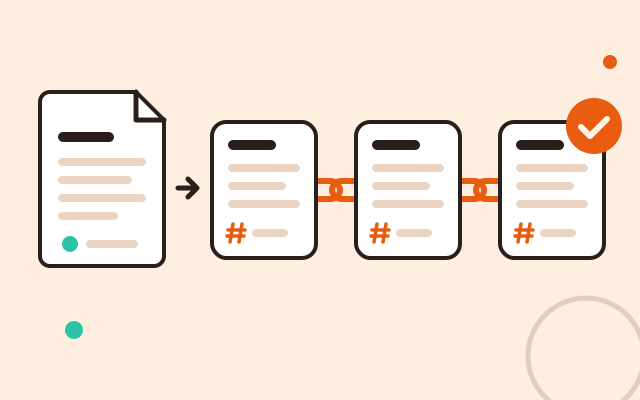
A study's path, from registration to independent verification.
Registration first
The study's protocol (the data to be used, the rules, the costs and the decision rule) is written and committed to version control before any result is seen. Until the protocol, run exactly as written, shows otherwise, the default verdict is NO EDGE.
One shot
The confirmatory measurement is run once, by a human, on a clean working tree. A result nobody likes is not re-run.
Seal
The result is appended to a hash-chained record. The chain reveals any later change to the record or to its order, and the verdict can be recomputed from the evidence in the record.
Family rule
Every registration states in advance that a negative verdict closes the whole strategy family. Thresholds are not loosened, and parameters are not re-tuned for "one more try".
Independent verification
A sealed study can be packaged as a report bundle: a third party can re-derive the verdict without an internet connection, using nothing but Python's standard library.
So far
None of the registered studies has found a validated edge; each was closed by its own rule, written in advance. That is the method working: the rules record an unwelcome result as plainly as a welcome one.
One example: the momentum-v2 study tested a momentum strategy, produced a sample that could be judged, and its verdict was NO EDGE; the momentum family was closed by its own rule. This study has been prepared as the report bundle described above.
Principles
From the software's own engineering principles.
Deterministic core
Calculations, validation rules and execution policies are deterministic. Language models may interpret, summarize and propose; they do not replace deterministic financial logic.
Models are components, not authorities
A model's output is an input to the system, not the final word; it is untrusted until validated.
Fail closed
When required evidence, validation or authorization is missing, the system stops rather than guesses. Uncertainty reduces authority; it never increases it.
Traceable evidence
Verified facts, calculated results, model interpretations, assumptions and unresolved uncertainty are kept apart.
Tests are specifications
Tests describe intended behavior, boundary conditions and failure modes; a passing suite is necessary, not sufficient.
No secrets in code
Credentials and permissions are never embedded in source code; security is designed into boundaries, not added afterwards.
Status
Financial AI is a research project under active development. Its source code is not public.
For questions about the project: info@bayraktarrobotik.com